

Cubic (CUB)#
Pearson symbol: cP
Cubic lattice is described by the class CUB.
It is defined by one parameter: \(a\) with primitive and conventional lattice:
\[ \begin{align}\begin{aligned}\boldsymbol{a}_1 = (a, 0, 0)\\\boldsymbol{a}_2 = (0, a, 0)\\\boldsymbol{a}_3 = (0, 0, a)\end{aligned}\end{align} \]
Variations#
There are no variations for cubic lattice.
One example is predefined: cub with \(a = \pi\).
Example structure#
Default kpath: \(\Gamma-X-M-\Gamma-R-X\vert M-R\).
Picture |
Code |
|---|---|
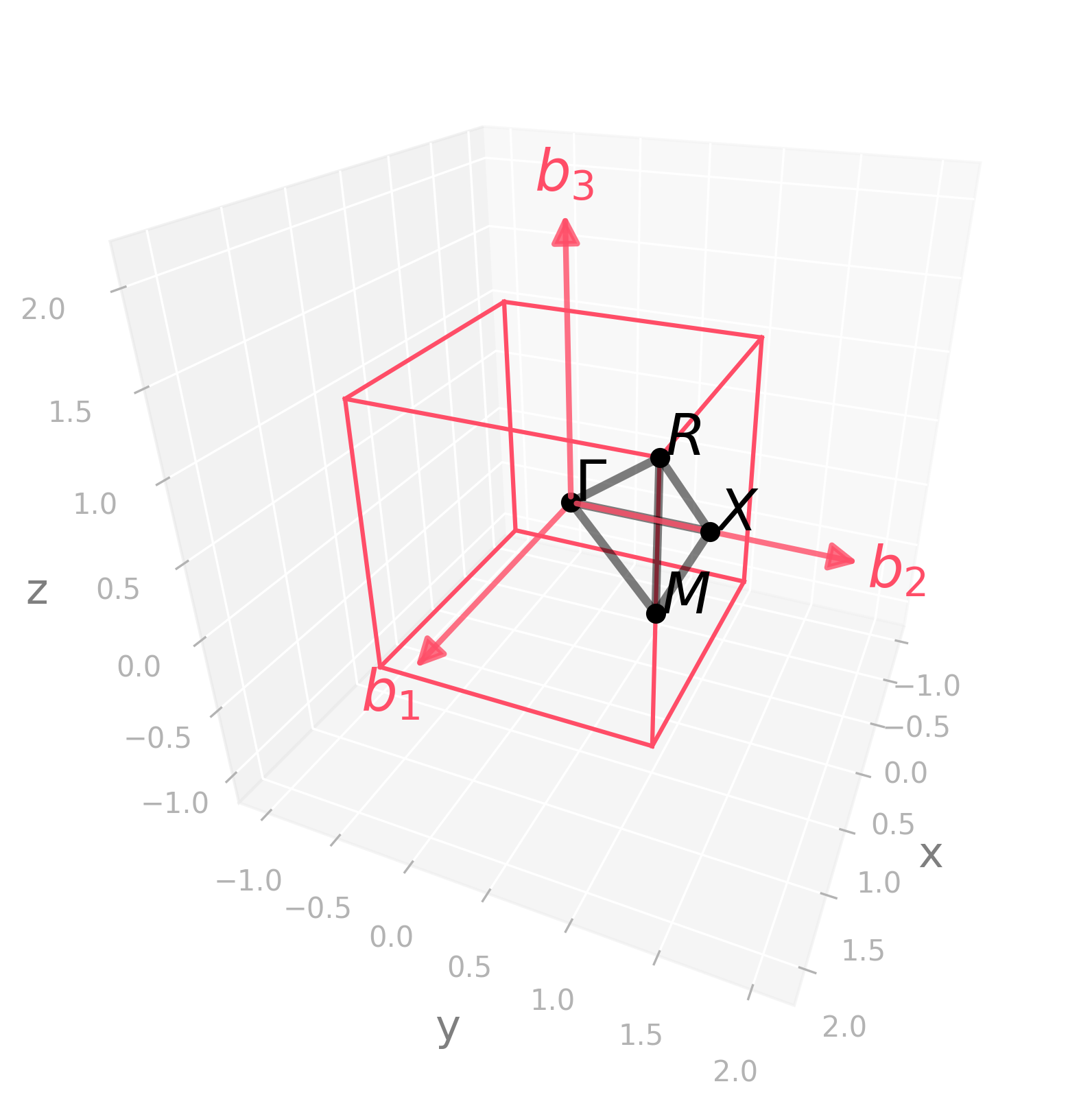
|
import radtools as rad

l = rad.lattice_example(f"CUB")
l.plot("brillouin-kpath")
# Save an image:
l.savefig(
    "cub_brillouin.png",
    elev=28,
    azim=23,
    dpi=300,
   bbox_inches="tight",
)
# Interactive plot:
l.show(elev=28, azim=23)
|
Picture |
Code |
|---|---|
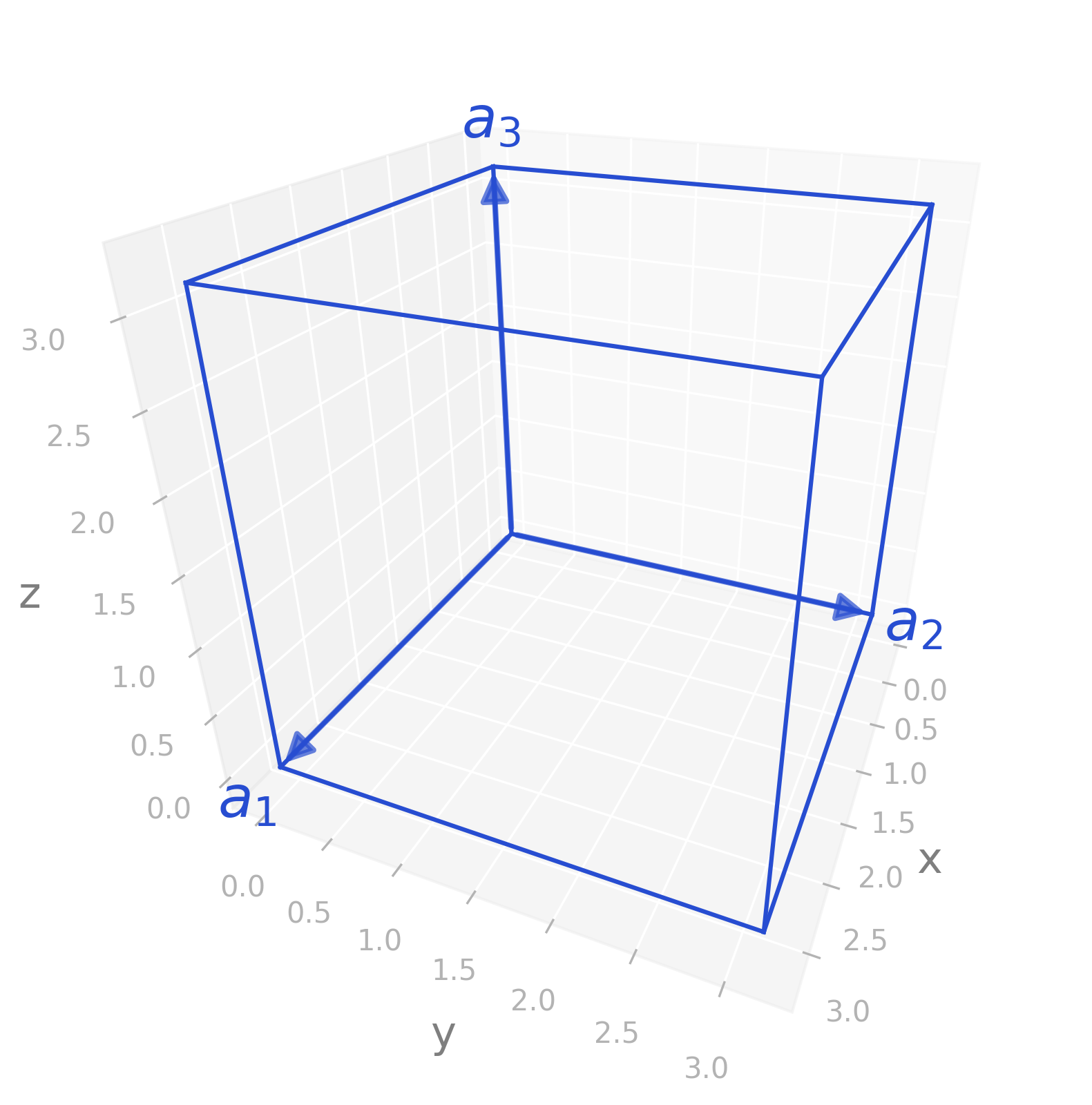
|
import radtools as rad

l = rad.lattice_example(f"CUB")
l.plot("primitive")
# Save an image:
l.savefig(
    "cub_real.png",
    elev=28,
    azim=23,
    dpi=300,
   bbox_inches="tight",
)
# Interactive plot:
l.show(elev=28, azim=23)
|
Picture |
Code |
|---|---|
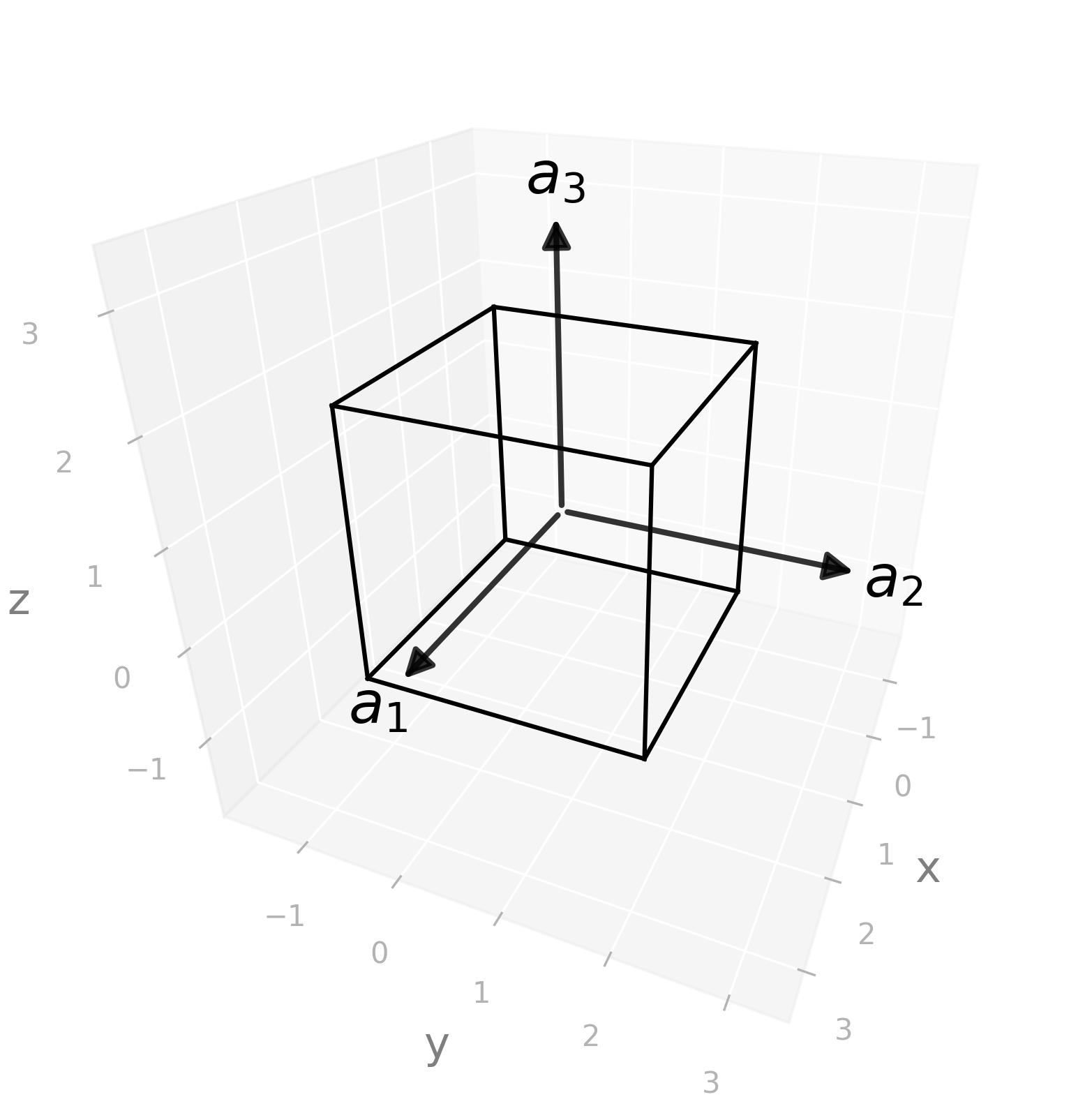
|
import radtools as rad

l = rad.lattice_example(f"CUB")
l.plot("wigner-seitz")
# Save an image:
l.savefig(
    "cub_wigner-seitz.png",
    elev=28,
    azim=23,
    dpi=300,
   bbox_inches="tight",
)
# Interactive plot:
l.show(elev=28, azim=23)
|