

Monoclinic (MCL)#
Pearson symbol: mP
Monoclinic lattice is described by the class MCL.
It is defined by four parameter: \(a\), \(b\), \(c\) and \(\alpha\) with primitive and conventional lattice:
Order of parameters: \(b \le c\), \(\alpha < 90^{\circ}\).
Variations#
There are two variations for monoclinic lattice.
One example is predefined: mcl with
MCL(pi, 1.3 * pi, 1.6 * pi, alpha=75)
\(a = \pi\), \(b = 1.3 \pi\) \(c = 1.6 \pi\) and \(\alpha = 75^{\circ}\).
Example structure#
Default kpath: \(\Gamma-Y-H-C-E-M_1-A-X-H_1\vert M-D-Z\vert Y-D\).
Picture |
Code |
|---|---|
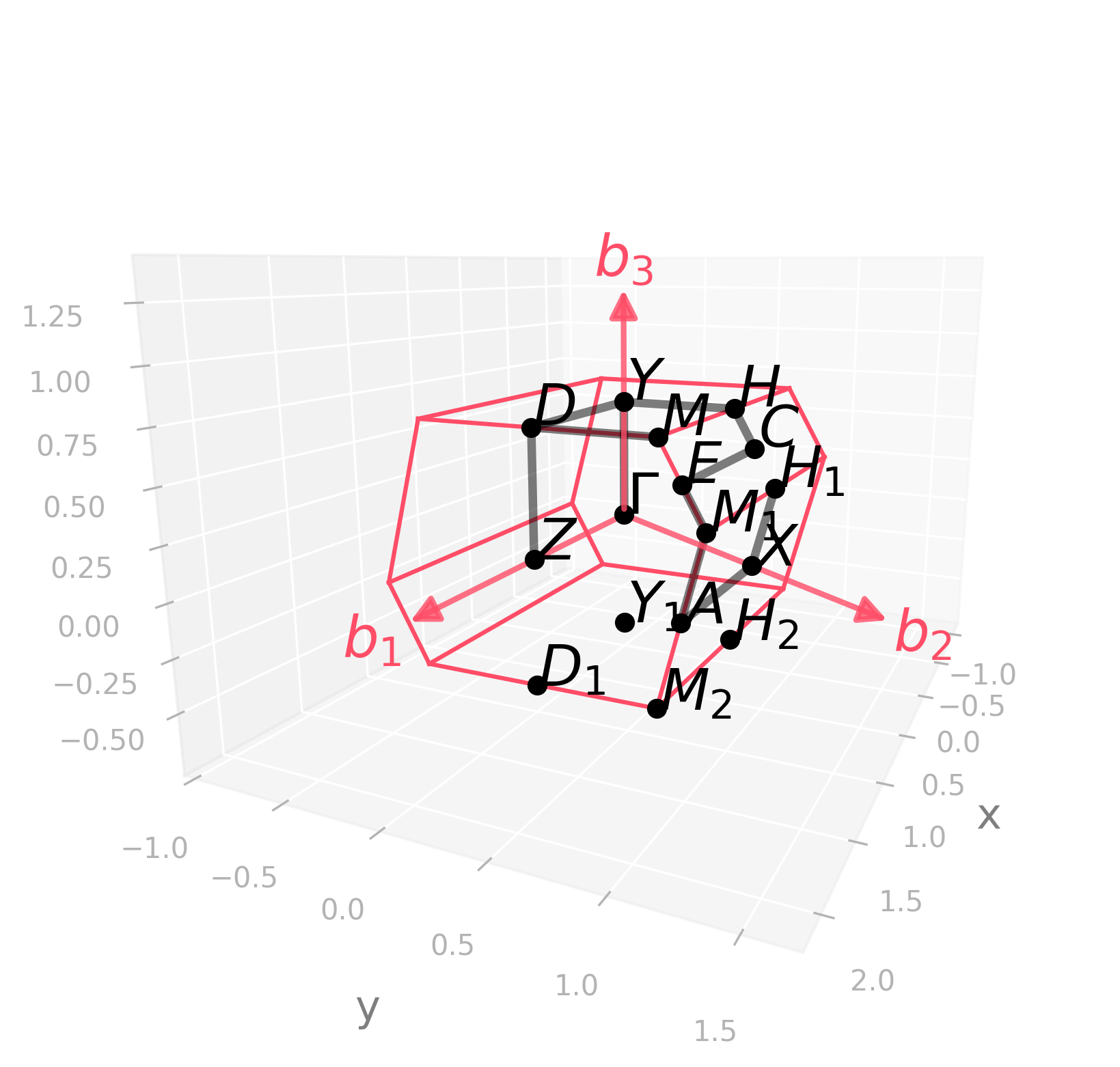
|
import radtools as rad

l = rad.lattice_example(f"MCL")
l.plot("brillouin-kpath")
# Save an image:
l.savefig(
    "mcl_brillouin.png",
    elev=12,
    azim=25,
    dpi=300,
   bbox_inches="tight",
)
# Interactive plot:
l.show(elev=12, azim=25)
|
Picture |
Code |
|---|---|
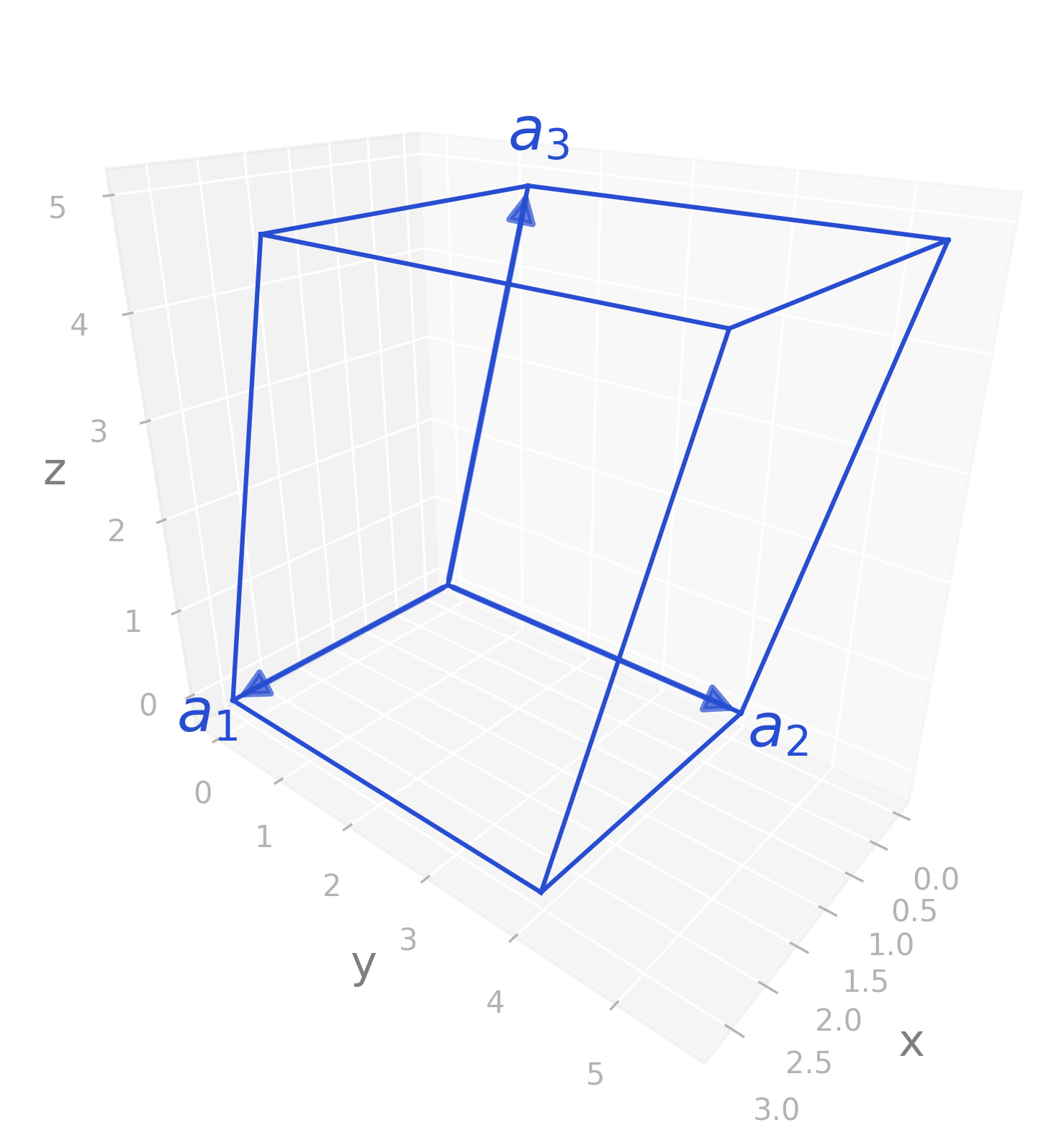
|
import radtools as rad

l = rad.lattice_example(f"MCL")
l.plot("primitive")
# Save an image:
l.savefig(
    "mcl_real.png",
    elev=25,
    azim=40,
    dpi=300,
   bbox_inches="tight",
)
# Interactive plot:
l.show(elev=25, azim=40)
|
Picture |
Code |
|---|---|
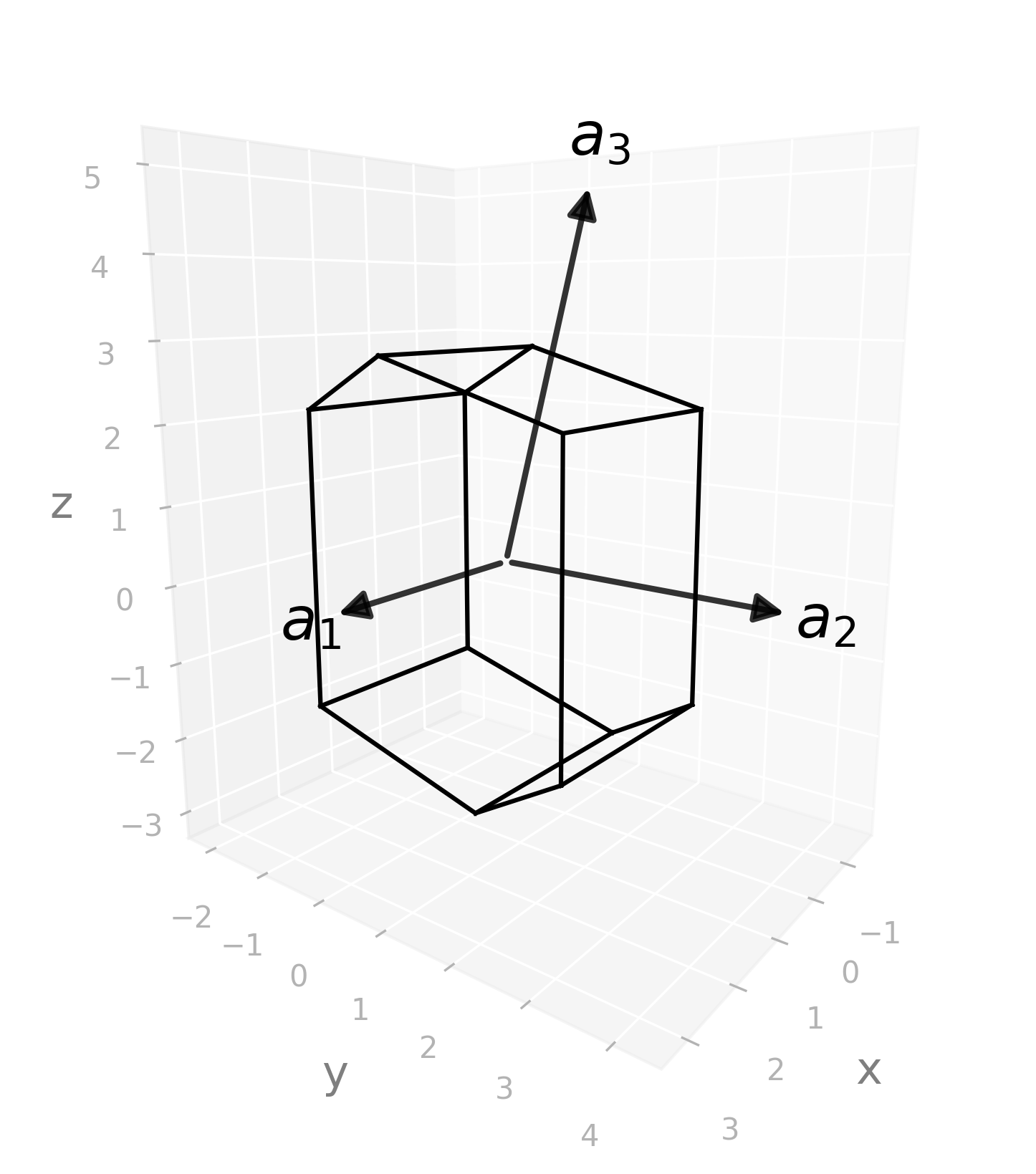
|
import radtools as rad

l = rad.lattice_example(f"MCL")
l.plot("wigner-seitz")
# Save an image:
l.savefig(
    "mcl_wigner-seitz.png",
    elev=11,
    azim=37,
    dpi=300,
   bbox_inches="tight",
)
# Interactive plot:
l.show(elev=11, azim=37)
|
Ordering of lattice parameters#
TODO
Edge cases#
If (\(\alpha = 60^{\circ}\) or \(\alpha = 120^{\circ}\)) and \(b = c\), then the lattice is Hexagonal (HEX).
If (\(\alpha = 30^{\circ}\) or \(\alpha = 150^{\circ}\) or \(\alpha = 45^{\circ}\) or \(\alpha = 145^{\circ}\)) and \(b = c\), then the lattice is Base-centred orthorhombic (ORCC).
If (\(\alpha = 60^{\circ}\) or \(\alpha = 120^{\circ}\)) and \(a \ne b = c/2\), then the lattice is Orthorhombic (ORC).
If \(a \ne b \ne c\) and \(\alpha = 90^{\circ}\), then the lattice is Orthorhombic (ORC).
If (\(\alpha = 60^{\circ}\) or \(\alpha = 120^{\circ}\)) and \(a = b = c/2\), then the lattice is Tetragonal (TET).
If (\(a = b \ne c\) or \(a = c \ne b\) or \(b = c \ne a\)) and \(\alpha = 90^{\circ}\), then the lattice is Tetragonal (TET).
If \(a = b = c\) and \(\alpha = 90^{\circ}\), then the lattice is Cubic (CUB).